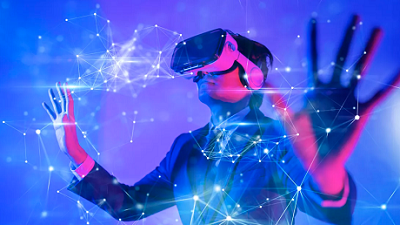
 You've probably noticed: The term "metaverse" is everywhere. Last year, Facebook rebranded itself as Meta, a not-so-subtle nod to the social network's ambition to be a prime mover in the next step on the internet. Microsoft's AltspaceVR stakes a claim to being a metaverse, and the software giant just announced it would buy ActivisionBlizzard for $69 billion, part of an expansion into virtual worlds. Rec Room and world-building games, like Roblox and Minecraft, all get rolled into discussions of what the metaverse is. The metaverse isn't a new idea, and the term has been in circulation for decades. The technological concepts behind it – virtual reality, augmented reality and 3D computing – are older still. The current boom in interest is just the most recent peak in a years-long push to make these advances useful to everybody. What's changed is a shift in understanding, a conviction that the internet needs to be reimagined. How far-reaching those changes end up being is anyone's guess. After all, the road map for the metaverse is half-paved, and it's still not entirely clear that it'll be completed as promised. What's for sure is that if there's money to be made, big companies will be involved. In addition to Meta and Microsoft, Qualcomm, Nvidia, Valve, Epic, HTC, and Apple are all dreaming up new ways of connecting online. It's unclear whether these projects will be standalone or interconnected. What is clear is that you'll be hearing more about the metaverse in the years ahead. Unsatisfyingly, the metaverse is a squishy concept. An evolution of the internet, it's often described as online spaces where people can socialize, work and play as avatars. Those spaces are shared and always available; they don't disappear when you've finished using them, like a Zoom call. The description is so broad that many people say the metaverse already exists in the digital worlds of Roblox, Minecraft, and Fortnite, which allow players to gather in 2D environments. Second Life, a social and gaming platform that's been around for nearly two decades, is a metaverse and is being revamped. Facebook boss Mark Zuckerberg, Microsoft CEO Satya Nadella, and other proponents see a deeper, more immersive experience that marries a host of existing technologies, such as VR headsets, mobile devices, personal computers, and cloud-connected servers. These futurists envision the development of a 3D virtual world, one that you'll optionally enter while wearing a headset or AR glasses. There's no agreement on whether you'll need VR or AR to get to the metaverse, but they pretty much go hand in hand, suggesting that these headsets will be compatible with whatever's on offer. A new wave of VR and mixed reality headsets are expected to be announced this year from Meta, Sony, Apple, and maybe others. That remains to be seen. No standards for the metaverse exist, and lots of companies are clamoring to lay the groundwork others will follow. Facebook, Microsoft, Sony, Epic Games, and a bunch of smaller companies are all working on projects with the hopes of grabbing a first-mover advantage. It's unclear whether one company's VR headset will be compatible with another company's expansive multiplayer world or cloud-based graphics. Most companies promise a metaverse that allows other companies in. But that requires them to agree on how they work together. Meta, which plans to spend $10 billion on its metaverse projects this year, says interoperability is crucial. If you have an avatar on Facebook, you should be able to use it on a Microsoft platform. That sounds pretty straightforward and suggests a single metaverse. But we're far from that vision. Try moving a skin or dance move you've bought to personalize your Fortnite avatar to another platform and you'll quickly find those add-ons are stuck in the battle royale game. For more in-depth study visit OUR FORUM.  While Huawei Technologies remains firmly on a United States cyber-security black list, its long-time ally Thailand is opening wide to the Chinese tech giant. On December 19, Thai Prime Minister Prayut Chan-ocha presided over an inauguration event for the “Siriraj World Class 5G Smart Hospital”, which was likewise attended by Huawei Thailand chief executive officer Abel Deng, among others. The event also marked the launch of a Joint Innovation Lab between Bangkok’s Siriraj Hospital and Huawei to incubate innovative 5G medical applications. 5G, or fifth generation, refers to the latest telecommunications technology standard that began rolling out in 2019 and of which Huawei is a pioneer and market leader. 5G not only means faster communications and connections to electronic devices but also enables businesses to collect vast amounts of data for further use in digital platforms and application development as well as startup businesses, all key aspects of the modernized, digital economy Thailand is striving to create. Siriraj Hospital happens to be the hospital in which the much-revered late Thai monarch King Bhumibol Adulyadej (Rama IX) spent his twilight years and was founded by his father, the Harvard-educated Prince Mahidol Adulyadej, remembered as the “father of modern medicine” in the kingdom. Huawei’s establishment of close collaboration with such a royally connected institution represents a public relations coup and underscores the Chinese tech giant’s growing clout in Thailand’s economy, observers note. “It sends a very strong signal that Thailand is opening the door to Huawei, especially during a public health crisis,” said Benjamin Zawacki, senior program specialist for Southeast Asian Regional Security at The Asia Foundation in Thailand and author of the book “Thailand: Shifting Ground between the US and Rising China.” China has arguably scored more points from the Covid-19 pandemic in Thailand than the United States, which was perceived as slow to provide access to US-made vaccines – Pfizer and Moderna – while China was quick to deliver Sinovac and Sinopharm alternatives. While both Chinese-made shots have been deemed less effective against the virus, especially the now fast-spreading Omicron variant, they were ostensibly on hand during the early days of the pandemic when the Thai government was under heavy criticism for botching the vaccine rollout. Huawei has been similarly astute in leveraging the pandemic to its advantage. As early as June 2020, Siriraj and Huawei had developed 5G technology applications to launch self-driving vehicles for “contactless” delivery of medical supplies to Covid cases in the hospital. Since the Covid outbreak, Siriraj Hospital, and Huawei have also piloted 5G portable medical boxes, 5G medical carts and 5G smart hospital beds and the two partners expect that 30 5G medical applications will be incubated and promoted nationwide in 2022. Given its greater speed and enhanced data storage capacity, 5G is deemed particularly well suited to medical applications which require stable, uninterrupted telecommunication connections. It is one of several huge potential markets for Huawei in Thailand, which is promoting itself as a regional medical and wellness hub for global travelers and patients. “We will introduce 5G hospitals, 5G ambulances, and AI-assisted solutions in 10 hospitals,” said Huawei management in written responses to Asia Times questions. That is the tip of the 5G iceberg. “We will also build over three 5G city benchmarks to support the APEC (Asia-Pacific Economic Cooperation) Summit to be hosted in Thailand (in November) and in line with the EEC’s digital vision we will deploy ten 5G factories in the EEC, including a 5G automobile manufacturing factory,” said Huawei. The Eastern Economic Corridor (EEC), comprising three provinces on Thailand’s eastern coastline adjacent to Bangkok, is a pivotal program for uplifting the economy and escaping the so-called middle-income trap by stimulating future growth through the promotion of high-tech industries, many of which will rely on 5G technology in such areas as automation, robotics, and logistics. To learn more please visit OUR FORUM.  TRUTH Social is America’s “Big Tent” social media platform that encourages an open, free, and honest global conversation without discriminating against political ideology. Former US President Donald Trump is all set to unveil his own social media platform which is called Truth Social on February 21. Trump was banned from all social media platforms after he was found guilty of inciting violence against the Capitol Hill building. After being away from social media, Trump will reconnect with his fans through his own social media platform. The Truth Social app is already listed on Apple App Store. Truth Social, the Trump Media & Technology Group (TMTG) is similar to Twitter. The app allows people to follow other people and shows the latest trends, the demo photos of the app revealed. However, instead of the tweet, the posts will be called “truth” because it is apparently a Truth social media app and nothing other than the truth shall be written on the platform. The app is available for pre-orders before going live on US President's Day. It will be available on the App Store but both Apple and Trump’s management has refused to comment on the launch of the social media app. However, a source close to Trump informed Reuters that the app will be available on February 21. Trump not only will launch a platform similar to Twitter, but he also has another platform in the pipeline which will be similar to YouTube. If that’s not all, a Podcast network will also be launched by TMTG. The Reuters report reveals that the TMTG is valued at $5.3 billion (roughly Rs. 39,430 crore), the shares of the app reportedly shot up by 20 per cent after Reuters reported the app’s listing on App Store. Trump was banned from all the social media platforms including YouTube, Facebook and Twitter for encouraging his supporters to ransack the Capitol Hill building on January 6. After getting banned from social media, Donald Trump had filed a lawsuit against big tech companies. In his lawsuit, Trump has targeted Facebook and its CEO Mark Zuckerberg, Twitter CEO Jack Dorsey and Google CEO Sundar Pichai for removing him from the social media apps. Trump had said that he wants the court "to order an immediate halt to social media companies” for censoring the American people. “We are demanding an end to the shadow-banning, a stop to the silencing, and a stop to the blacklisting, banishing and cancelling that you know so well,” Trump said during a press conference. He further added that if they could ban a president, they could ban anybody. |
Latest Articles
|